Table of Contents

How Performance Marketers Can Optimize Audience Targeting in the Signal Era

- Audience targeting has shifted from something marketers built by hand to something Meta, Google, and TikTok's own algorithms build automatically, using whatever conversion signal they're fed.
- Most omnichannel brands only feed ad platforms their DTC website data, a fraction of total sales, so the algorithm is learning and optimizing for the whole business based on a fraction of the real buyer base.
- Brij Signal sends verified retail and marketplace purchase events into ad platforms’ Conversions APIs, which lifts reported attribution and ROAS right away and improves the algorithm's targeting over time.
- Lookalike audiences and suppression lists can then be built from a brand's entire customer base, not just DTC buyers, improving targeting and cutting wasted spend on people who already bought.
Optimizing audience targeting is a massive lever for success for performance marketers, but not in the way it used to work.
For years, building an audience meant a marketer manually assembling interest lists, custom uploads, and lookalikes. Now Meta, Google, and TikTok's own algorithms do most of that work, deciding who sees an ad based on whatever conversion signal they're given. That's a real gain in performance, but it's also created a problem: the algorithm can only build an audience out of the buyers it can see, and for most omnichannel brands, that's a fraction of who's really buying.
What Is Audience Targeting?
In ad-platform terms, an audience is the group of people a campaign's algorithm decides to show ads to. Sometimes a brand builds that group directly: an interest list, a custom audience uploaded from an email file, a lookalike modeled off a seed list of known buyers. Increasingly, the platform builds it itself: Meta's Advantage+ Shopping Campaigns, Google's Performance Max, and TikTok's Smart+ all use broad, algorithm-defined targeting instead of a marketer-built list, and let the machine learning model find the buyers. Either way, the audience is only as good as the data used to define it.
How We Got Here: Ad Platforms Started Controlling Targeting
For most of the last decade, performance marketers did the targeting. You picked interests, built custom audiences from your customer list, layered on lookalikes, and the platform served ads to the people you specified.
Two things broke that model. Apple's App Tracking Transparency changes in 2021 cut off a lot of the third-party signal platforms used to build and refine audiences on their own, which pushed Meta, Google, and TikTok to lean harder on first-party conversion data sent directly from advertisers through each platform's Conversions API, or CAPI, the pipe that carries purchase events from a brand's own systems into the ad platform.
At the same time, machine learning got good enough that broad, algorithm-run targeting started consistently outperforming manually built segments, because the model can test far more combinations of behavior and intent than a human ever could.
Meta leaned into this with Advantage+. Google did it with Performance Max. TikTok followed with Smart+. The result is the same across all three: the platform now decides who sees your ad.
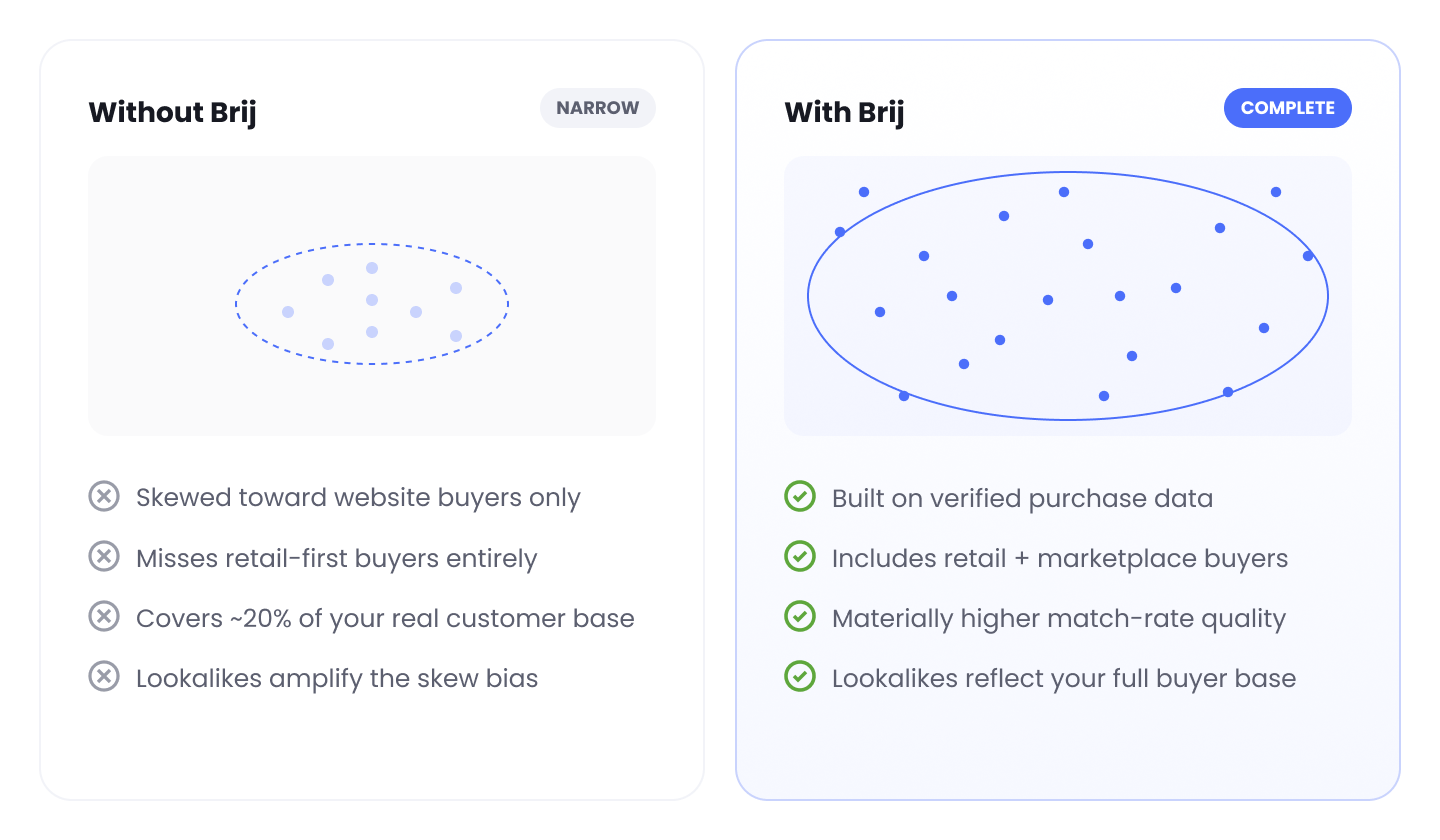
That's a real gain in performance, but it comes with a catch. The algorithm can only see purchases happening directly on your site. And for most omnichannel brands, that’s only ~20% of their business.
Your Audience Is Only as Good as the Data You Feed It
The other 80%, the purchases at Target, Walmart, Ulta, or through Amazon, never reach the ad platform as a conversion event.
The algorithm thinks it's optimizing your whole business, using DTC as the only evidence it has of what that business actually looks like. That's a distorted view of your real customer base, and the model has no way of knowing it's distorted.
So the algorithm optimizes toward whoever looks like your DTC buyers already do, a group that's self-selected for being comfortable buying direct online, and that usually skews toward certain demographics, geographies, and price sensitivities. Anyone who looks like your typical retail buyer, and might convert just as well or better, never gets shown the ad, because the model has no evidence they exist.
This is the retail black box. The sale is real. The buyer is real. The algorithm just can't see either one.
Brij Signal: Turning Retail and Marketplace Purchases into Deterministic Signal
This is the specific gap Brij Signal is built to close. When a shopper buys your product at retail or on a marketplace, scans a Brij QR code, registers their purchase, or uploads a receipt, Brij verifies that purchase and sends it, as a deterministic, identity-matched event, into Meta, Google, and TikTok's Conversions APIs alongside your existing DTC conversion data.
This isn't a modeled estimate of who probably bought your product. It's a verified purchase tied to a real person, hashed and sent server-side, the same event structure Meta, Google, and TikTok already expect from a checkout. And because it's a verified, incentivized purchase and not just a site visit, the underlying data is materially higher quality than what a pixel picks up from browsing traffic. That single change is what makes everything else here, custom audiences and lookalikes built from your whole customer base, and suppression lists that actually work, possible in the first place.
Build Custom Audiences and Lookalikes from Your Whole Customer Base
Custom audiences used to be limited to whoever showed up in your own systems: email subscribers, site visitors, DTC purchasers. Retail and marketplace buyers never made the list, because you had no way to identify them. Now you can.
Lookalikes get the same upgrade, and the stakes are higher because they're used to find new buyers, not just re-engage known ones. A lookalike modeled on DTC purchasers finds more people who look like online-only shoppers. A lookalike modeled on your whole customer base finds people who look like whoever actually buys your product, online or in the aisle. The gap between those two audiences is exactly the group of potential buyers who wouldn't have seen your ad otherwise.
Suppressions: Stop Paying to "Acquire" People Who Already Bought
The flip side of a better lookalike is a better suppression list, and it's the part of this that most brands haven't been able to touch until now. If you can't see a purchase made at retail or on a marketplace, you also can't exclude that buyer from your acquisition campaigns. Which means you're very likely paying, right now, to "acquire" someone who already bought your product last month at Target.
Once Brij verifies those purchases, they become suppressible the same way a DTC purchase already is. Recent retail and marketplace buyers come out of the acquisition audience and move into retention, cross-sell, or replenishment campaigns instead, where that spend actually does something useful. You stop bidding against yourself for customers you already have, and the acquisition budget goes further because it's finally being spent on people who are actually new.
The Compounding Advantage
When you turn on Brij Signal, you get an immediate lift in ROAS, and attribution becomes more accurate by measuring the halo effect and showing which retail purchases were influenced by ads.
The long term value is training the algorithms on retail buyers for better lookalike audiences. This pushes every ad dollar further by targeting more likely customers (lower CAC). Every verified purchase Brij sends into Meta, Google, and TikTok makes the next lookalike sharper, the next suppression list more complete, and the next round of algorithmic targeting a little more accurate than the last, because the model is finally training on your total sales, not the fraction it happened to see.
By feeding your ad platforms deterministic offline conversion signal now, you can start the process and ensure your algorithms are trained by peak season. Book a demo with Brij to see how shelf-to-signal works for your retail and marketplace data specifically.