Table of Contents

GS1 Sunrise 2027: The Barcode to QR Shift

- Sunrise 2027 is a GS1-led global initiative to transition retail from 1D UPC barcodes to 2D QR-style codes that can encode rich product data and be scanned at both point of sale and by smartphones.
- GS1 Digital Link is the technical standard behind those 2D codes. It turns a product's existing GTIN into a structured web address that a checkout scanner, a warehouse system, and a consumer's phone can all read from the same code.
- 2D QR codes enable storage of batch numbers, expiration dates, serial numbers, authentication data, and dynamic links, transforming packaging into a real-time information channel aligned with consumer demand for transparency.
- Retailers and brands gain operational benefits from structured product data, including improved traceability, recall management, regulatory compliance, and inventory accuracy at the point of sale.
- Brij extends GS1 QR functionality by enabling verified digital experiences, first-party data capture, and post-purchase engagement tied directly to serialized products and omnichannel systems.
For more than 50 years, the UPC barcode has powered retail. It’s simple. Reliable. Universal.
But retail is evolving.
A global initiative called Sunrise 2027, led by GS1, is accelerating the shift from traditional 1D barcodes to 2D QR-style codes at point of sale.
By 2027, retailers are expected to be capable of scanning these new codes, marking one of the most significant upgrades to product identification in decades.
This isn’t just a technical update. It’s a structural shift in how products connect to data, systems, and consumers.
What Is Sunrise 2027?
Sunrise 2027 is GS1’s global initiative to transition from linear UPC barcodes to 2D barcodes, such as QR codes powered by GS1 standards.
Unlike traditional barcodes that store only a product identifier (GTIN), 2D codes can encode significantly more information, including:
- Batch or lot numbers
- Expiration dates
- Serial numbers
- Dynamic web links
- Authentication data
- Regulatory and traceability details
Importantly, these QR codes can be scanned both at checkout and by smartphones. That dual functionality changes everything.
During the transition period, many products will carry both a 1D barcode and a 2D code. But over time, the 2D code is positioned to become the primary standard.
What's Actually Inside a GS1 Digital Link URL?
The standard making all of this possible is called GS1 Digital Link. It's what turns a 2D code from "just a bigger barcode" into a structured web address — one a checkout scanner reads exactly like today's barcode, and a smartphone reads as a live product experience.
A typical GS1 Digital Link URL looks like this:
https://id.gs1.org/01/09520123456788/10/ABC123/17/251231
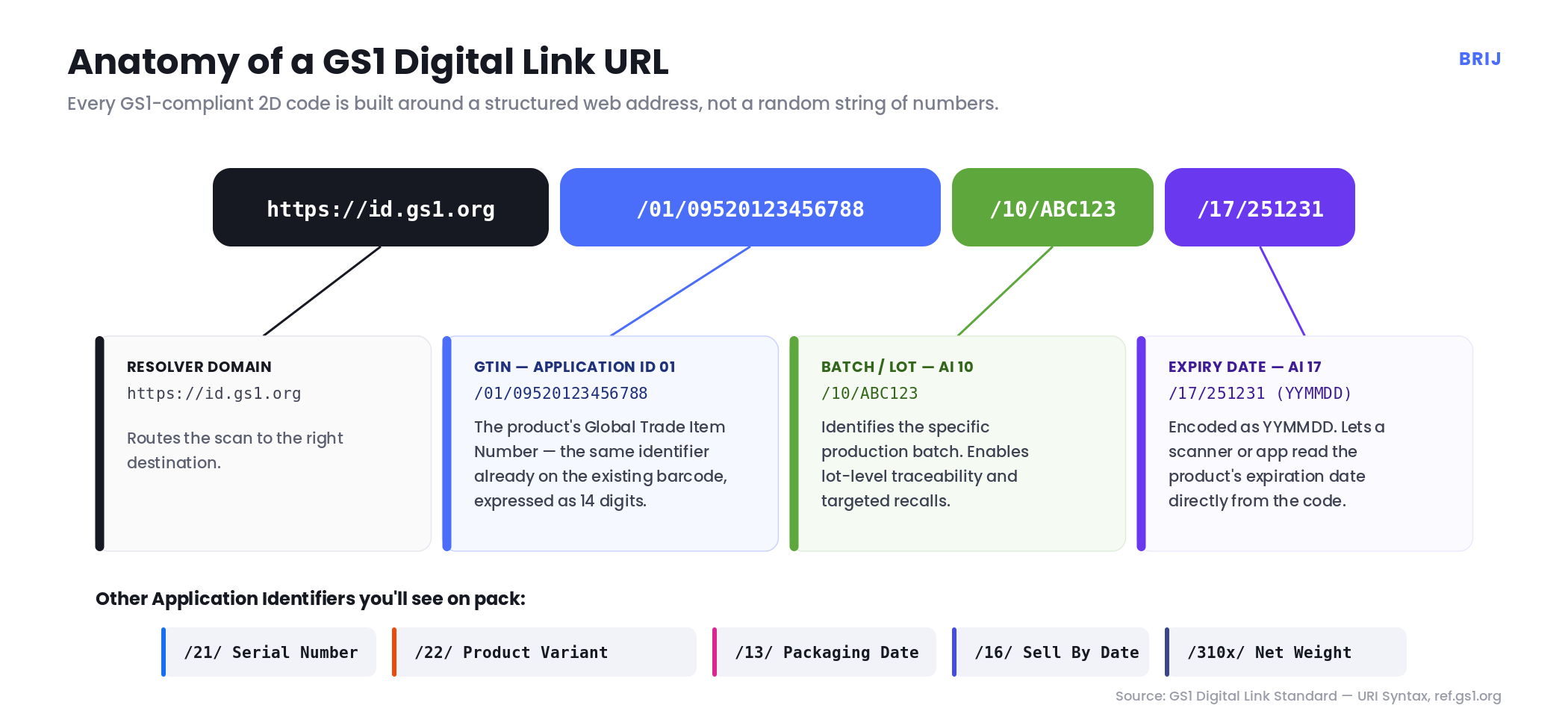
Here's what each part means:
Resolver Domain — https://id.gs1.org
The resolver domain is what receives the scan and routes it to the right destination.
Application Identifier /01/ — GTIN
/01/09520123456788
The /01/ identifies the GTIN, the product's Global Trade Item Number, the same identifier already on the existing barcode, expressed as 14 digits (zero-padded if it's shorter).
Application Identifier /10/ — Batch or Lot Number
/10/ABC123
The /10/ AI identifies the specific batch or lot a product belongs to, which is what makes lot-level traceability and targeted recalls possible.
Application Identifier /17/ — Expiration Date
/17/251231
The /17/ AI encodes the product's expiry date in YYMMDD format, so it can be read directly off the code by a scanner or an app.
Other Commonly Used Application Identifiers
/21/— Serial number/22/— Consumer product variant/13/— Packaging date/16/— Sell-by date/310x/— Net weight in kilograms
None of this requires a new GTIN. GS1 Digital Link is built on top of the identifier a brand already has, it just gives that identifier a structured, scannable web address.
Source: GS1 Digital Link Standard – URI Syntax, GS1
Why This Shift Matters
According to recent GS1 research:
- 77% say product information is important when making a purchase
- 62% are willing to spend more for products that provide detailed information
- 79% are more likely to purchase products with a scannable QR code that delivers additional product information
What information is most important to consumers? The survey revealed that nutrition facts, ingredients and materials, safety information, country of origin, allergen disclosures, and recall alerts were the most sought-after details.
This isn’t a niche demand. It’s mainstream purchasing behavior.
Packaging becomes more than a label. It becomes a trusted, real-time information channel at a time when consumers are actively looking for this transparency.
For brands, Sunrise 2027 can help them align more directly with how consumers already want to shop and get the data to better understand their customers.
More Data at Point of Sale
Retailers gain access to richer, structured product data – improving traceability, recall management, and inventory accuracy.
Regulatory & Supply Chain Readiness
Serialized and batch-level data embedded in a scannable code support compliance, safety, and operational precision.
A Built-In Consumer Touchpoint
Unlike traditional UPCs, QR codes are consumer-facing by default. One scan can unlock product education, sustainability details, usage instructions, loyalty programs, or brand experiences.
Sunrise 2027 ultimately allows for brands to transform every product into a connected digital asset.
Brands that treat this as a compliance exercise will meet the requirement. Brands that treat this as a strategic opportunity will unlock measurable engagement, first-party data, and post-purchase experiences at scale.
That’s where Brij comes in.
One Code Instead of Two
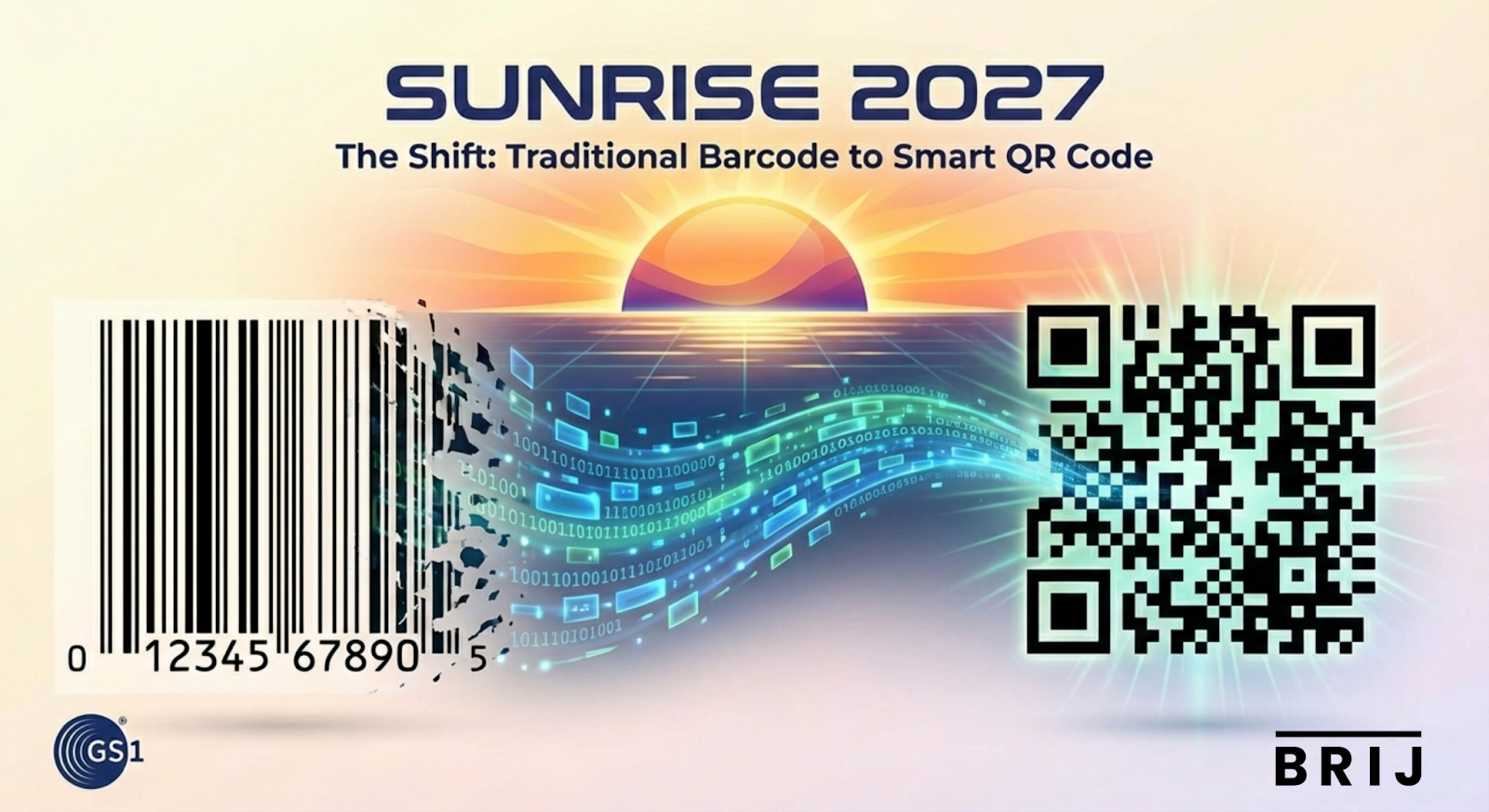
During the Sunrise 2027 transition, GS1 recommends printing both the legacy 1D barcode and the new 2D code side by side, so retailers whose scanners haven't upgraded yet can still ring up the sale at checkout.
But that's a transition state, not the end state.
Once a retailer's point-of-sale systems can read 2D codes, brands no longer need to carry both formats on pack. A single GS1 Digital Link QR code does everything the UPC barcode did — identify the product at checkout — plus everything a UPC barcode couldn't: batch data, expiration dates, and a live link to content, all from one code.
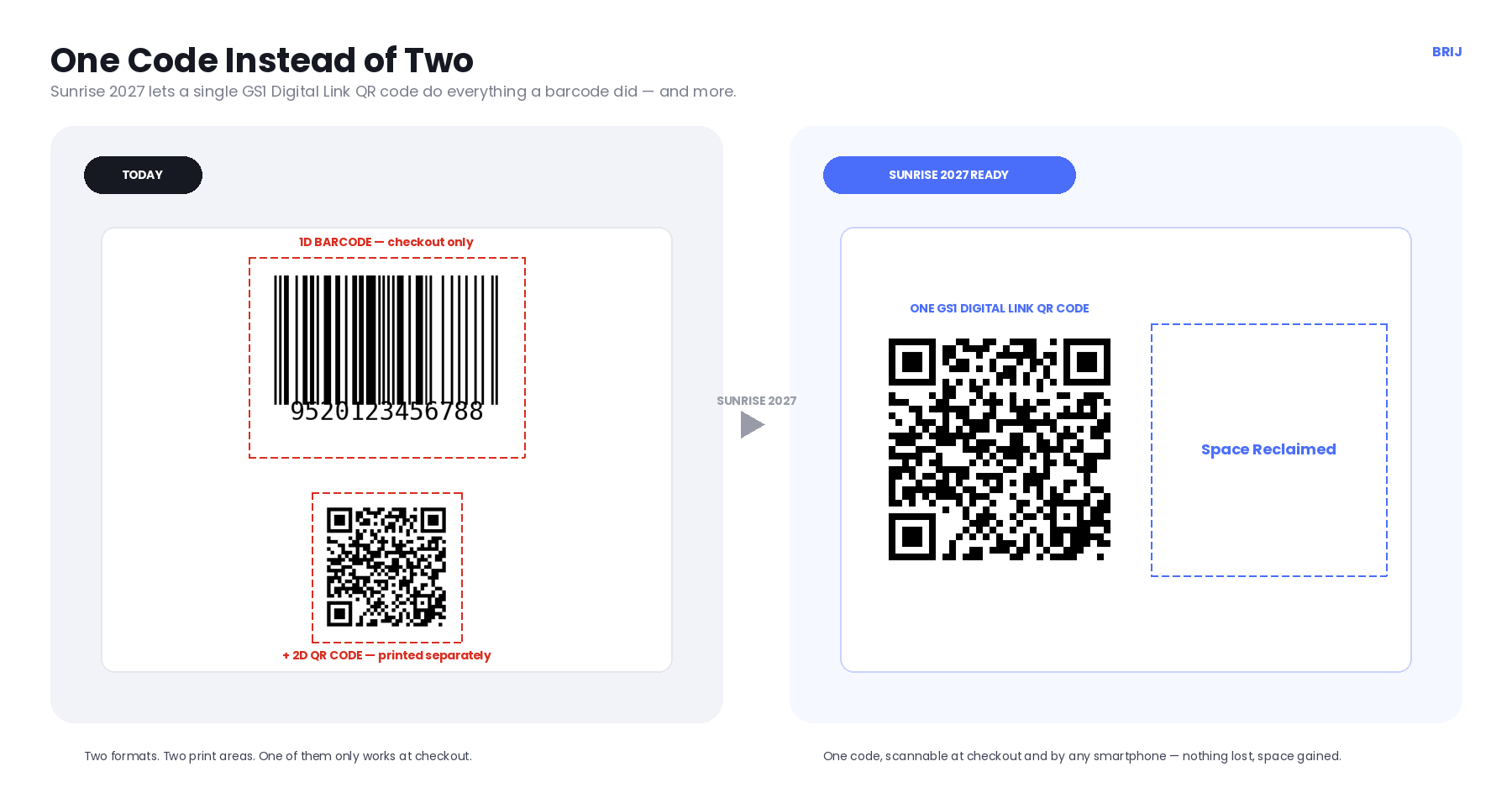
For brands, that's real packaging real estate back. Every square inch currently split between a barcode and a QR code becomes space that can go toward ingredient callouts, sustainability messaging, or simply a cleaner label, once a brand's retailers are far enough along to drop the second code.
Where Brij Fits in the Sunrise 2027 Transition
Brij was built for this shift.
As GS1-enabled QR codes become standard at retail, brands will need more than code generation. They will need infrastructure to power what happens after the scan.
Brij turns serialized and GS1-compliant QR codes into:
- Verified product experiences
- First-party data capture moments
- Warranty registrations
- Loyalty enrollment flows
- Rebates or sweepstakes
- Educational content
- Authenticated engagement campaigns
- Retail and CRM integrations
Instead of a static redirect, Brij enables dynamic, trackable, brand-controlled digital journeys tied directly to physical products.
That capability only becomes exponentially more powerful when QR codes are universally scannable at checkout.
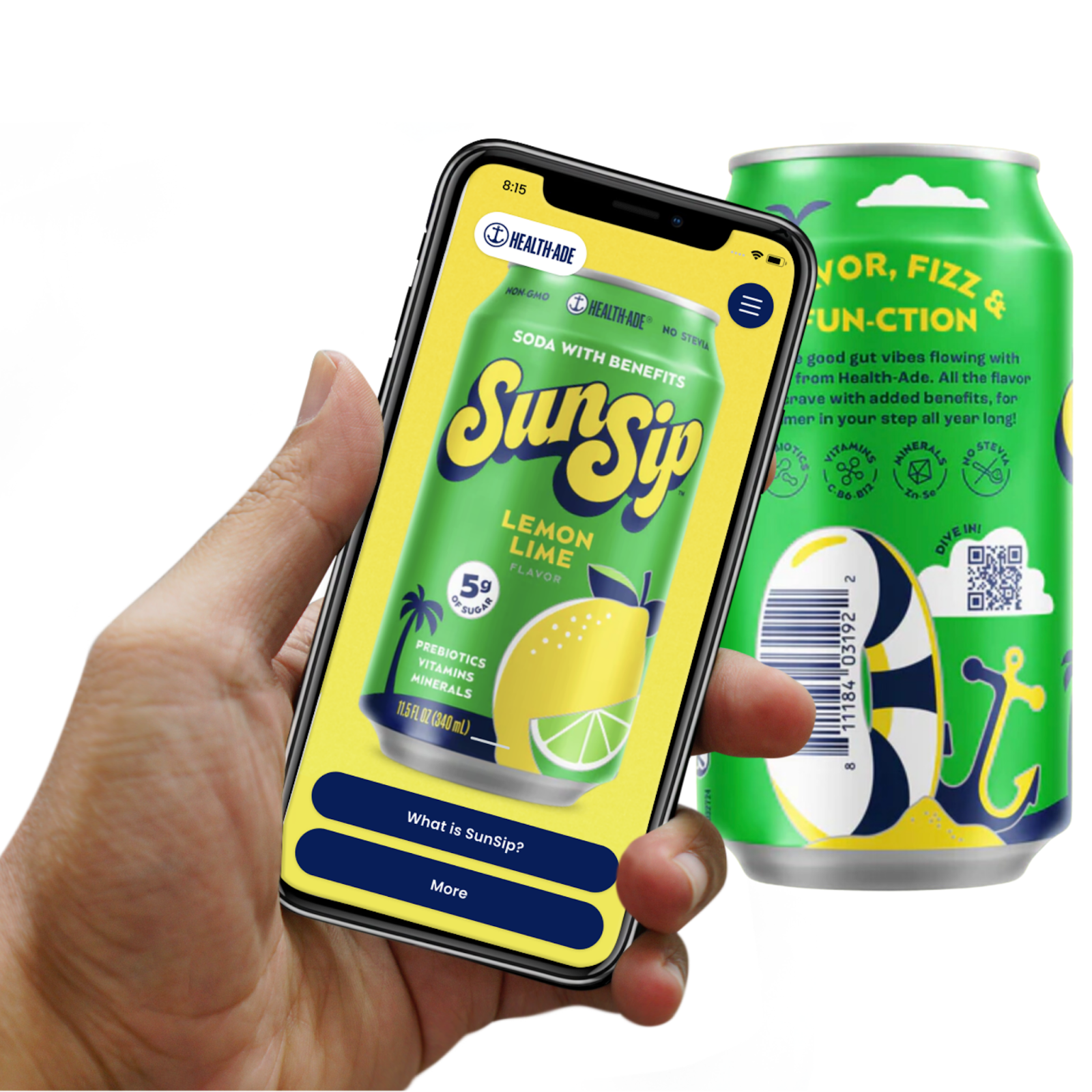
QR Codes as a Digital Bridge
Sunrise 2027 makes packages capable of being scanned. Brij makes every scan valuable.
By connecting QR scans to Shopify, Klaviyo, CRM systems, and retail workflows, Brij transforms a regulatory upgrade into a revenue-driving channel.
This creates three immediate advantages for brands:
1. Own the Post-Purchase Relationship
Every product becomes a direct-to-consumer touchpoint — even when purchased in-store.
2. Capture Verified First-Party Data
Serialized scans enable authenticated engagement tied to real product ownership.
3. Unlock Lifecycle Marketing
Batch-based campaigns, replenishment reminders, recall notifications, and personalized follow-ups become possible.
Looking Ahead
Retail is becoming smarter, packaging is becoming interactive, and data is becoming more easily embedded at the product level.
Sunrise 2027 accelerates that transformation.
For brands prepared to leverage it, the shift from barcode to QR is an opportunity to improve your omnichannel marketing strategy by connecting offline and online channels and owning the customer relationship.
And with the right platform in place, every scan becomes an opportunity.
Brij is already in touch with GS1 and actively tracking the Sunrise 2027 rollout. Schedule time to chat with our team to learn how this shift can positively impact your business.