Build your growth strategy, not the tech beneath it.
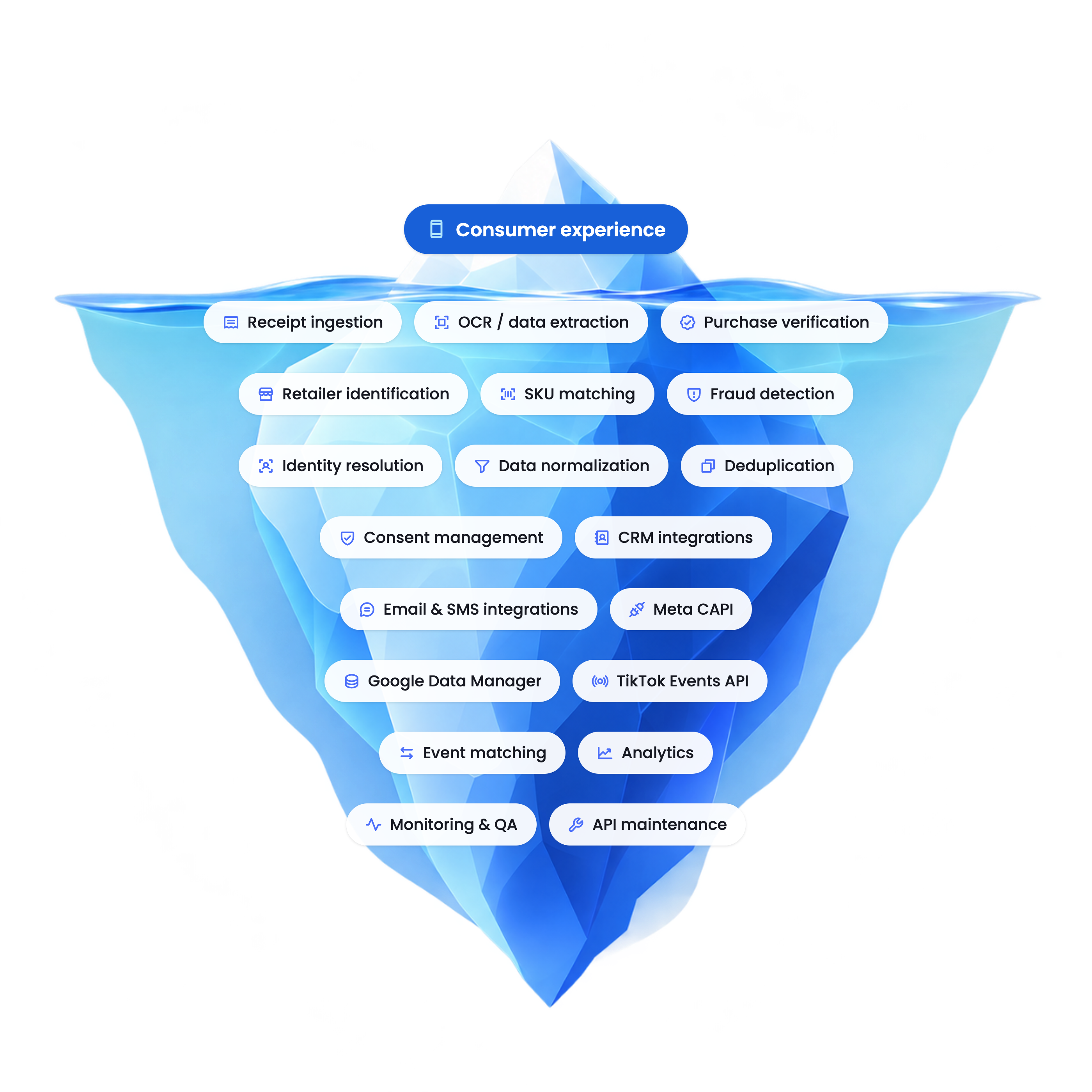
Building a form is easy. Building the infrastructure to capture, verify, structure, activate, secure, and continuously maintain retail purchase data is not.
Brij gives your team the complete infrastructure to identify retail buyers and turn their purchases into actionable data across your marketing stack.



.svg)




Brands using Brij have seen:
Brij vs. Building It Yourself
Using Brij
When it comes to data capture, Brij enables anyone on your team to create digital experiences using a drag-and-drop builder.
For data activation, Brij's technology handles everything: compliance, receipt verification, data structuring, passing data to your CRM and ad platforms, and more. No ongoing upkeep, QA'ing, or development resources from your team required.
Building In-House
Building in-house isn't as simple as throwing together a landing page with a form, then setting up quick integrations.
Verifying and transforming retail purchase information into an actionable data layer requires significant development resources, along with a thorough QA process and ongoing management as platforms and APIs change.
Learn how Brij transforms raw retail data into signal.
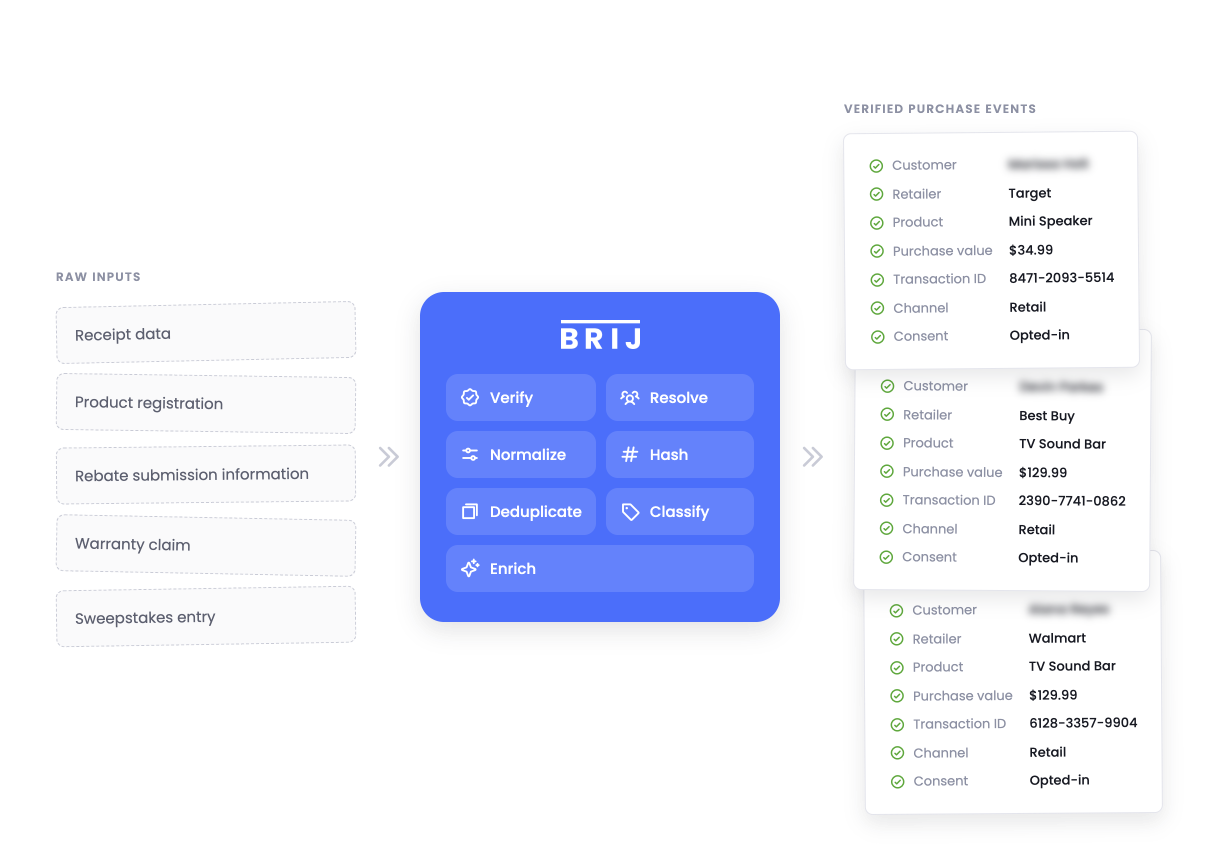
Capturing retail purchase data is only the first step. Before ad platforms can actually use that data, it has to be verified, cleaned, structured, matched, formatted, and continuously maintained. Brij handles that entire process for you.
Brij turns messy retail purchase data into clean, usable signal.
Raw retail data isn’t ready to send directly to an ad platform. Brij first transforms it into a verified, structured purchase record that Meta, Google, and TikTok can actually understand.
In addition to cleaning and structuring data, Brij verifies purchase data to confirm each transaction is legitimate before it becomes marketing signal.
Brij builds the right data pass for every ad platform.
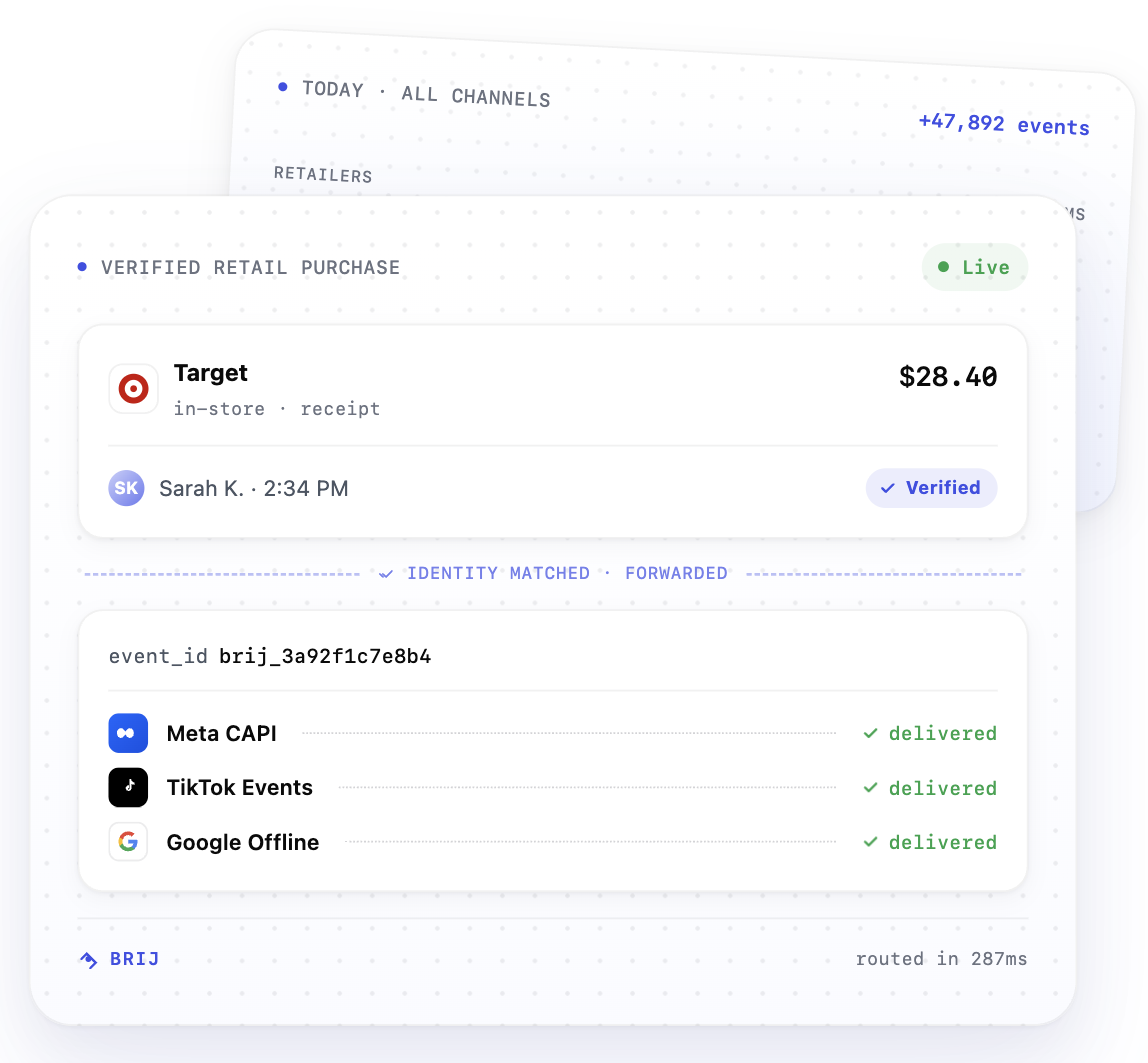
There is no universal format for sending retail purchase signal; Meta, Google, and TikTok each have their own APIs, authentication models, payload schemas, event taxonomies, validation rules, matching methodologies, and requirements for how an offline purchase should be classified.
Brij handles those custom configurations for you, structuring events for each destination to be used for audience building, attribution, and conversion optimization.
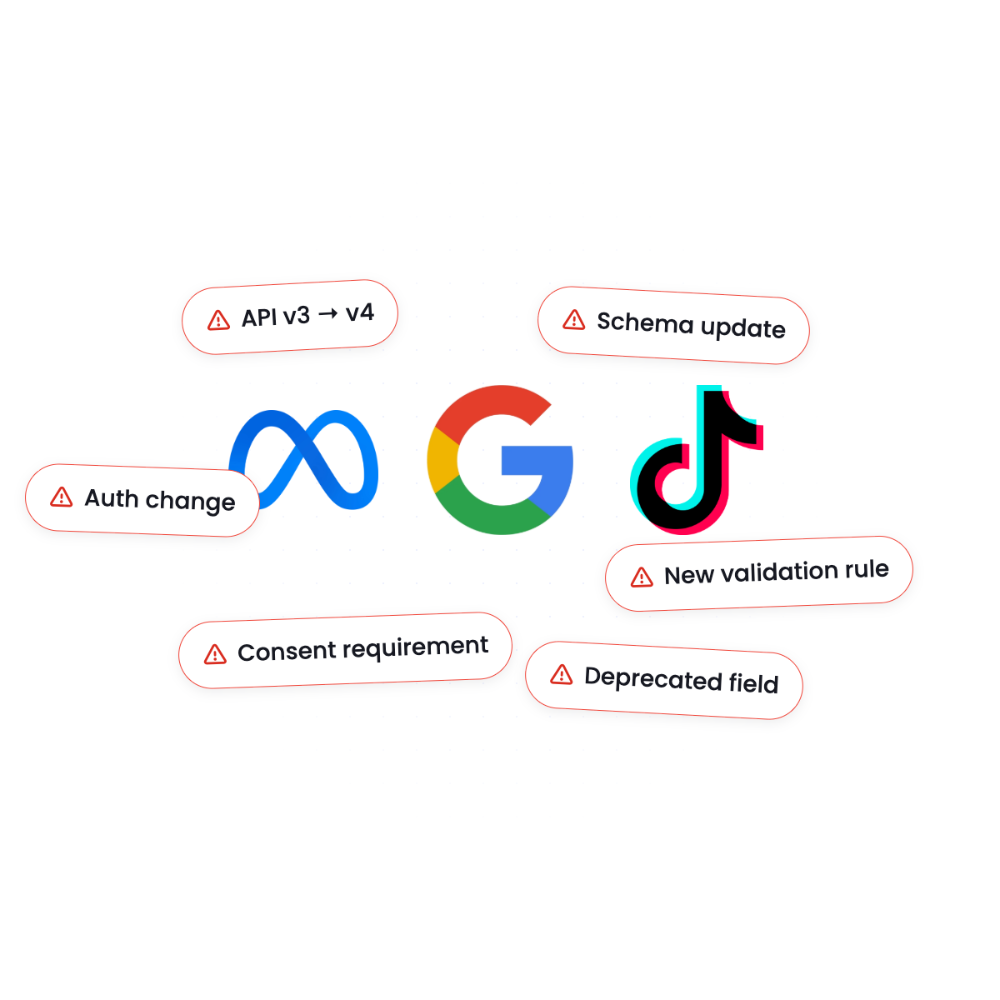
Brij handles ongoing QA, updates, and compliance needs for you.
Ad platforms continually change their APIs, authentication requirements, event schemas, conversion tracking systems, validation rules, and offline data infrastructure.
Brij handles this work, so your team isn't responsible for catching those changes, rebuilding integrations, diagnosing errors, and continually QAing the data flowing into every destination.
What brands say about Brij
Brij is giving us visibility into consumers we previously couldn't see. By capturing registrations from retail purchases and feeding that data back into our marketing ecosystem, we're improving our paid media efficiency across Google, TikTok and Meta, and building a more complete view of our consumer. Those insights are now shaping everything from CRM strategy to future product development.


Brij has become an important part of our retail growth strategy. Beyond the rebate itself, we've gained valuable insights into shopper behavior and retailer performance, helping us make smarter decisions across sales and marketing.


Get the signal, skip the build.
Frequently asked questions
What brands ask when evaluting Brij vs an in-house build.
We have a strong engineering team. Why can't we just build this?
The full build is receipt verification and fraud review, retailer and SKU parsing, conversion-optimized capture, server-side normalization and hashing, correct event typing and deduplication, three ad platform APIs plus CRM and email/SMS, consent gating per destination, and continuous QA. Then someone owns all of it indefinitely. Brij is that system, already in production and already maintained.
Isn't building internally cheaper than paying for another SaaS platform?
An internal solution also becomes a product your company owns indefinitely. Every API change, bug, integration update, new destination, and feature request becomes part of your engineering roadmap.
Brij lets you deploy existing infrastructure instead.
How long does Brij take to stand up?
We already collect product registrations. Can we keep our own capture and use Brij just for the data pass?
What happens when an ad platform changes its API?
With Brij, maintaining those integrations is part of our product. Your marketing team continues using the data while Brij manages the underlying infrastructure.
Why is receipt processing so complicated?
Brij turns that inconsistent input into verified, structured purchase data tied to an identified customer so it can actually be used by your marketing stack.
Do we still own the data if we use Brij?
Is Brij secure? What about compliance?
How does Brij help prevent fraudulent submissions?
This helps prevent suspicious or invalid submissions from becoming payouts, customer records, or downstream marketing signal.
Does Brij replace our existing tech stack?
Brij captures and structures retail and marketplace customer data, then makes it available to the tools your teams already use, including advertising platforms, CRM, email/SMS, commerce, and other systems.